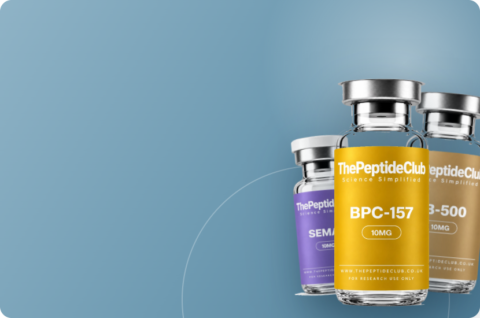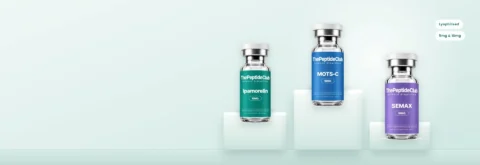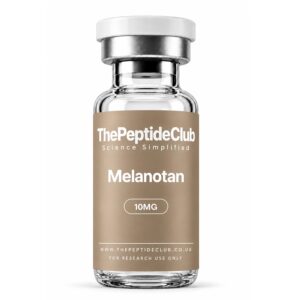
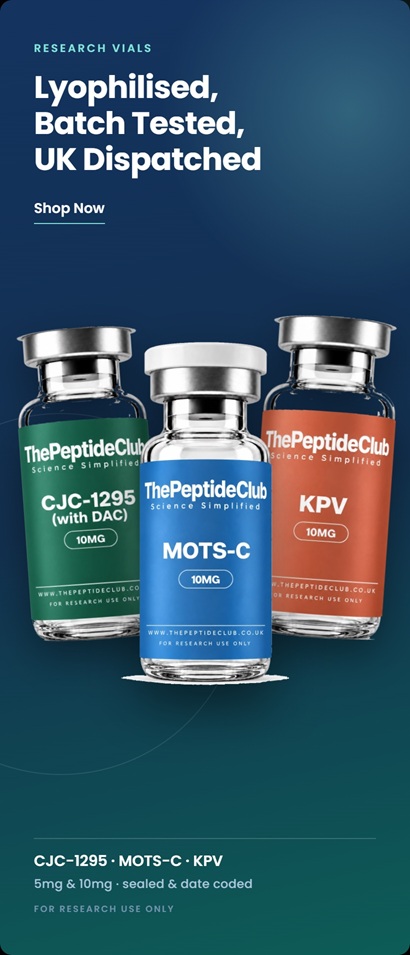
Open any research peptide vial and you will find the same thing: a small white cake or powder at the bottom of the glass. That dry format is no accident. Virtually every research peptide supplied to UK laboratories is lyophilised — freeze-dried — because removing water is the single most effective way to keep these delicate molecules stable from manufacture through shipping to long-term storage.
This guide explains the science of lyophilisation in plain language — strictly in the context of laboratory research materials.
What Lyophilisation Actually Is
Lyophilisation, or freeze-drying, is a dehydration process that removes water from a product while it remains frozen. The peptide solution is first frozen solid; then, under deep vacuum, the ice is made to sublimate — turning directly from solid to vapour without passing through the liquid phase. What remains is a dry, porous cake containing the peptide along with any buffer salts or stabilisers from the formulation.
The advantage over ordinary drying is temperature: water leaves as vapour while the product stays frozen, so the peptide never faces destructive heat. The result remains chemically stable for extended periods when kept dry, cool and protected from light.
Why Peptides Need It: The Enemies of Stability
Peptides are far more fragile in solution than in dry form. Water enables the main degradation pathways that concern analytical chemists:
- Hydrolysis — water molecules attack peptide bonds, gradually cleaving the chain into fragments.
- Deamidation — susceptible residues (particularly asparagine) convert to other forms, altering the molecule’s properties.
- Oxidation — dissolved oxygen reacts with residues such as methionine and cysteine, especially in the presence of light or trace metals.
- Aggregation — in concentrated solutions, peptide molecules can clump together into inactive aggregates.
All these reactions need the molecular mobility that water provides. Remove the water and reaction rates collapse — which is why a freeze-dried peptide stored at −20°C remains within specification far longer than the same sequence in solution.
The Three Stages of Freeze-Drying
Industrial lyophilisation is a carefully controlled cycle, not simply “freezing and drying.” It proceeds in three stages:
- Freezing. The peptide solution is cooled below its eutectic point so that water crystallises fully while the peptide and excipients concentrate in the remaining glassy phase. Controlled freezing produces small, uniform ice crystals, which later leave behind fine pores.
- Primary drying. Under vacuum, heat is applied very gently and the ice sublimates away. This is the longest stage — often the bulk of the cycle time — and it defines the cake’s porous structure.
- Secondary drying. Temperature is raised modestly to drive off the last bound water molecules adsorbed to the solid, bringing residual moisture down to the low single-digit percentages required for long-term stability.
Suppliers who control this cycle well produce elegant, intact cakes; a rushed or poorly controlled cycle yields collapsed, shrunken material. The visual appearance of the cake is therefore a genuine — if rough — quality indicator on receipt.
What a Good Lyophilised Cake Looks Like
When your order arrives, take a moment to inspect the vials before storing them. A well-lyophilised peptide typically presents as a uniform white to off-white cake or powder occupying the bottom of the vial, sometimes with a slightly textured surface from the pore structure left by sublimated ice.
Minor cosmetic variation between batches is normal. But a collapsed cake, significant discolouration, or visible moisture inside a sealed vial can indicate a compromised seal or poor cycle — photograph it and contact the supplier before storing the material.
Stability in Transit and Storage
Freeze-drying also transforms the logistics of peptide supply. A dry cake tolerates the rigours of shipping far better than a solution ever could, which is what makes tracked UK dispatch of research peptides practical in the first place. That said, lyophilisation reduces risk — it does not eliminate it. Heat and humidity during transit can still degrade material over time, which is why quality-focused suppliers maintain cold-chain handling from their freezers to the courier, using insulated packaging for every order.
On arrival, the same principles apply in your laboratory: transfer vials promptly to appropriate storage, keep them sealed until needed, and protect them from light and moisture. Our FAQs cover delivery and handling questions in more detail.
What This Means for Your Laboratory
For the working researcher, the practical takeaways are straightforward. Buy lyophilised material from suppliers who control their freeze-drying and can document it; inspect the cake on arrival as a basic quality check; and store sealed vials cold, dark and dry to preserve the stability that lyophilisation provides. These simple habits protect both your materials and the reproducibility of the work built on them.
You can browse our range of lyophilised research peptide vials in the shop, or learn more about who we are on the homepage.
FAQs
Why are research peptides supplied as a powder instead of a liquid?
Peptides degrade far more quickly in solution, where water enables hydrolysis, oxidation and aggregation. Freeze-drying removes the water while keeping the product frozen, producing a stable dry cake with a much longer usable life.
Does lyophilisation change the peptide itself?
No. Lyophilisation removes water without altering the amino acid sequence. The peptide’s identity and purity — as documented on its Certificate of Analysis — are unaffected by the drying process.
Do lyophilised peptides still need cold storage?
Yes. Freeze-drying greatly improves stability but does not make peptides indestructible. Sealed vials should still be stored cold (typically −20°C for long-term storage), protected from light and moisture, and kept for laboratory research use only.
Disclaimer: All products referenced are supplied strictly for laboratory research use only. They are not for human or veterinary consumption, nor for medical, therapeutic or diagnostic use.