The Certificate of Analysis — universally known as the COA — is the single most important document attached to any research peptide. It is the supplier’s formal, batch-specific declaration of what is in the vial: the compound’s identity, its measured purity, and the analytical evidence behind both claims. For laboratory professionals, knowing how to read a COA is as fundamental as knowing how to read a safety data sheet.
This guide walks through each section of a typical peptide COA and explains what the HPLC and mass spectrometry data actually show.
The Anatomy of a COA
A credible COA always contains the same core information — confirm each of the following:
- Product identification — the exact compound name (for example, NAD+ 500mg) matching the product you ordered.
- Batch or lot number — the unique identifier for the production batch. It must match the labelling on the product you receive.
- Dates — the date of manufacture or analysis, and ideally a retest or expiry date. Analytical data should be recent relative to the batch.
- Testing laboratory identity — the name of the laboratory that performed the analysis. Independent third-party laboratories carry more weight than in-house testing alone.
- Results table — the measured values for each test, alongside the specification or acceptance criterion applied.
Missing elements mean an incomplete document — barely better than no COA at all.
HPLC Purity Data: What You Are Looking At
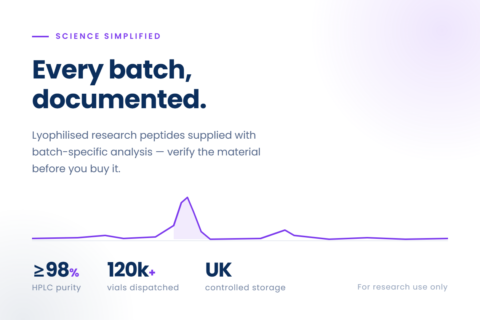
HPLC is the workhorse technique for peptide purity analysis: the dissolved peptide is pumped through a column, mixture components emerge at different times, and the result is a chromatogram — a series of peaks on a time axis.
The key figure is the main peak area percentage: the share of detected signal attributed to the target peptide. Reputable suppliers target ≥98% purity by HPLC; the small remaining fraction comprises trace-level synthesis impurities, which is normal and expected.
Look beyond the headline number: a trustworthy COA shows or references the actual chromatogram. Be cautious of purity figures with no supporting evidence, and treat any “100% purity” claim with deep scepticism — no analytical method can certify absolute purity.
Mass Spectrometry: Confirming Identity
HPLC measures purity but cannot confirm identity — that is the job of mass spectrometry (MS), which measures the molecular weight and compares it against the theoretical weight calculated from the amino acid sequence.
On a COA, you will typically see a reported mass (for example, the monoisotopic or average molecular mass) alongside the expected value. A match within the instrument’s tolerance confirms the identity of the compound — that the vial contains the sequence stated on the label, not a different peptide or an unrelated substance. Many laboratories run the two techniques together as LC-MS, producing purity and identity data from a single analysis.
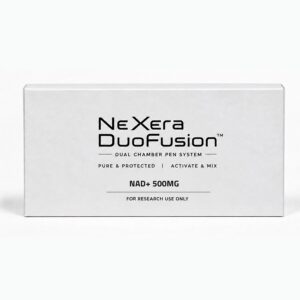
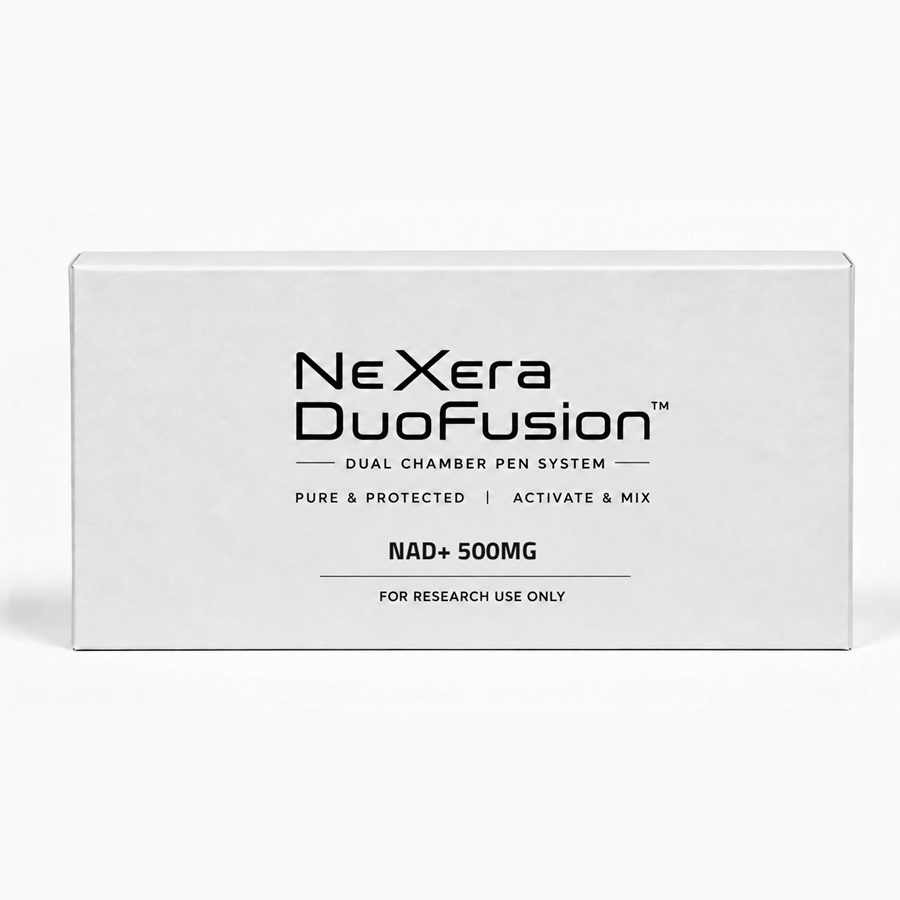
Both are needed: HPLC without MS leaves identity unconfirmed, and MS without HPLC leaves purity unknown. See how this looks in practice on the NAD+ 500mg page in our shop, supplied with its batch-specific certificate.
Purity vs Net Content: A Critical Distinction
One of the most misunderstood aspects of peptide documentation is the difference between purity and content. Purity (the HPLC figure) describes what fraction of the powder is the target peptide versus impurities. Net content describes how much peptide mass is actually present — because lyophilised powders also contain residual moisture and counter-ions (such as trifluoroacetate from purification) that contribute weight but are not peptide.
A vial labelled 10mg at 98% purity with 85% net content contains roughly 8.5mg of actual peptide — both figures are normal analytical realities. A thorough COA reports both separately; see our FAQs for more on documentation.
Red Flags on a COA
With the basics understood, here are the warning signs that should prompt further questions — or a different supplier:
- No batch or lot number, or a number that does not match the product labelling.
- A single “representative” COA reused across multiple batches instead of batch-specific documentation.
- No named testing laboratory, or testing performed only in-house with no independent verification.
- Missing mass spectrometry data — purity without identity confirmation is half a story.
- Unrealistic claims such as “100% pure” or chromatograms that look digitally fabricated.
- Stale analysis dates far removed from the batch’s manufacture date.
Legitimate suppliers welcome scrutiny of their documentation. If asking reasonable questions about a COA is met with evasion, that response is itself an answer. You can read about our approach to testing and transparency on our about us page, or contact us directly with any documentation queries.
FAQs
What is the difference between HPLC and mass spectrometry on a COA?
HPLC measures purity — what percentage of the material is the target peptide. Mass spectrometry confirms identity — that the material is actually the stated compound, by matching its measured molecular weight to the expected value. A complete COA includes both.
Is 98% purity good enough for research?
Yes — ≥98% HPLC purity is the accepted standard for research-grade peptides. The remaining fraction comprises trace-level synthesis impurities. Claims of 100% purity are not analytically credible and should be treated as a red flag.
Should every batch have its own COA?
Absolutely. Peptide synthesis varies slightly from batch to batch, so a certificate is only meaningful if it refers to the specific batch you receive. Always check that the batch number on the COA matches your product labelling.
Disclaimer: All products referenced are supplied strictly for laboratory research use only. They are not for human or veterinary consumption, nor for medical, therapeutic or diagnostic use.